Dorchester
Dorchester is a delightfully typical English market town and has been the county town of Dorset since 1305. The town was founded by the Romans in 43AD. Lovely Georgian buildings off the steep main street, broad Walks, and a busy townscape. Its river is the Frome. A very pleasant place to live and to visit and a good starting place for tours of Dorset.
There is plenty of accommodation in the town and in the places around for a very pleasant Dorset holiday.
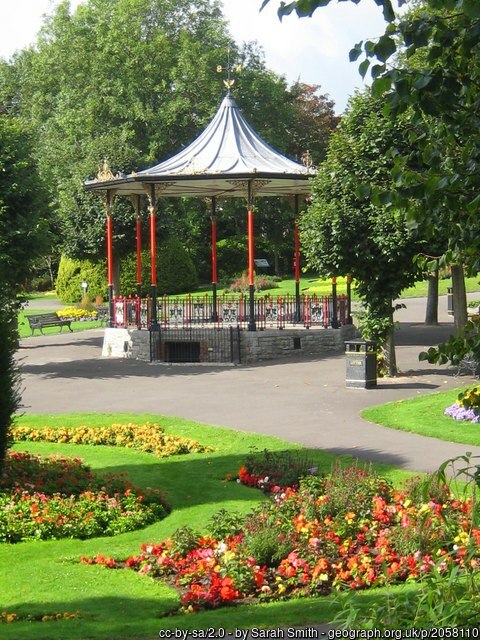
The Bandstand in Dorchester Borough Council Gardens
Photograph © Sarah Smith
The town has an ancient history with plenty of attractions. Dorchester makes a good base for Thomas Hardy enthusiasts as the writer had strong connections with the town.
Market day is Wednesdays. There are lots of shops with the main area for this activity being South Street where there are both local and High Street chain shops.

Travelling to this attractive town
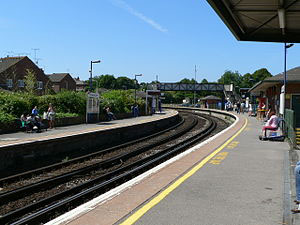
Dorchester South Railway Station
Photo in the public domain
Dorchester South is the station for the London, Waterloo, line.
Dorchester West is a smaller station, served by First Great Western, trains from Gloucester and Bristol Temple Meads. A useful connection from Maiden Newton for cyclists who do not wish to do the return cycle ride through the Frome Valley.
National Express coaches run between Weymouth and London Victoria, stopping here.
Local buses
There are plenty of local buses in and around the town.
Hire cars and taxis
Hire Cars and taxis are plentiful. (One very helpful taxi driver took us from Dorchester South Station to Lyme Regis with all our heavy luggage! His fare, contracted first, was very reasonable indeed! Life saver that day - thank you taxi driver, sorry I do not know your name.)
In and around the town
There is plenty to see in Dorchester. Whether you are a Thomas Hardy fan, it is shopping you want, museums an ancient hill fort, gardens, a roman villa, a cycling holiday or a pleasant break in Dorset.
Poundbury is a new town on the edge of Dorchester can perhaps be described as back to the future!
Poundbury Hill is a bronze age hill fort and like all those old hill forts has great views.
The area around Dorchester is an ancient in habitation, been around for thousands of years and those folk have left their mark in the landscape. As well as Poundbury Hill, there is Maiden Castle, Maumbury Rings, the Roman Town House and the Aqueduct. These places are well worth a visit. Click that link for an interesting read.
There are many famous people connected with the town including Thomas Hardy and more detail of these people are on this page.
There is a statue to Thomas Hardy in The Grove and one to William Barnes outside St Peter's Church. Reverend John White MA is buried in the church porch and there is a plaque to him.
Walks round Dorchester
A fine day and a walk is a good way to see a town. There are several walks and details can be found on a display board near the Town Pump in South Street close to the clock tower and Corn Exchange, or the Tourist Information Office in Antelope Walk.
Walk in the attractive Borough gardens amid colourful flower beds. It is an extensive area with a couple of tennis courts and a bowling green plus a large play area for the kiddies. There is a clock tower and a bandstand where live shows take place during the summer.
Dorset County Museum
A lovely Gothic building in High Street West has the largest Hardy collection in the world donated by his second wife, Florence. A Mecca for Hardy enthusiasts.
Other galleries hold collections of the Roman occupation of the area including artefacts from the Roman Villa, dinosaur footprints, history of the area, archeaological artefacts and geology of Dorset.
Old Crown Court and Cells
Old Shire Hall and Crown Court and Cells. Famous for the trial of the Tolpuddle Martyrs transported to Australia in the 1830's. They were convicted of swearing an oath to each other under a law from forty years earlier. The real reason was of course their protest regarding the lowering of agricultural wages for which they had founded their Friendly Society of Agricultural Labourers. They were eventually released, returned to England and some went on to Canada, one died in the workhouse.
The Keep Military Museum
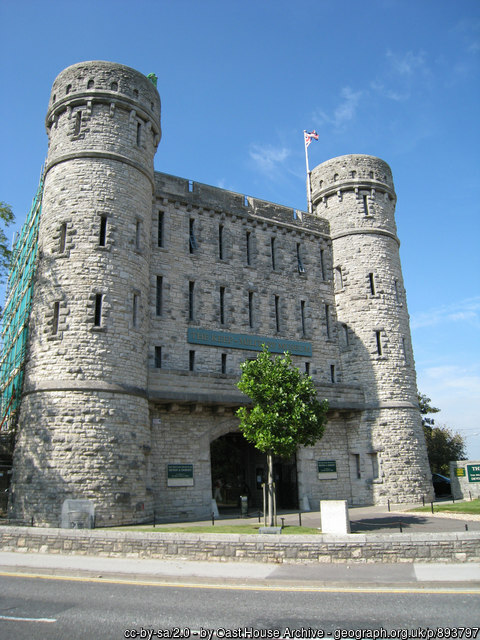
Keep Military Museum, Dorchester
Photograph © Oast House Archive
The Museum is situated in an impressive Grade II listed building - a large keep in Bridport Road – a building that just cannot be missed!
With their physical and their virtual museums, archives and research this is an extensive and ongoing project. A harmonious empathy of building and collection with a modern outlook on the web.
Their collection covers three floors and includes weapons, uniforms, medals and artefacts of The Devonshire Regiment, The Dorset Regiment, The Devonshire and Dorset Regiment, The Dorset Yeomanry, The Queen's Own Dorset Yeomanry, The Dorset Militia, The Royal Devon Yeomanry and 94 Field Regiment Royal Artillery.
There is a lift for the disabled and wheelchair access.
Go up on to the battlements, the views are incredible. The camera is a must have here.
Kingston Maurward Gardens and Animal Park
A 35 acre garden open most of the year with the best
times around mid May to October. Ornamental Lake, tree and nature
trails, small gardens each with their own theme and a walled garden. The
animal park has an interesting collection and children can feed some of
the animals. Recently they became members of the Rare Breeds Survival Trust.
The Palladian style house is not open. It was built in the early eighteenth century for George Pitt who was a cousin of the Prime Minister William Pitt. George Pitt died there in 1734. The original gardens were in the style of Capability Brown but were recreated in the present style between 1915 and 1920 by the Hanbury family. Opened to the public in 1991 and new plantings are put in every year to complement the extensive existing features.
The Dorchester County Show
The Dorchester County Show, is held in September on the outskirts of the town. Very popular with locals and visitors, presenting a large number of interesting events.
Cycle to Lyme Regis NCN2
The start of the NCN2 the The Sustrans Cycle route
starts here in the town. It is an ideal for a stopping off place for a
cycling holiday as several pedals into the surrounding countryside start
here. It makes an excellent short break too.
Other pages that may be of interest
Cycle Ride as a short holiday Dorchester to Lyme Regis
Return from Dorchester to Home
or you might prefer to browse some more, please do, you will find navigation buttons above on the left.


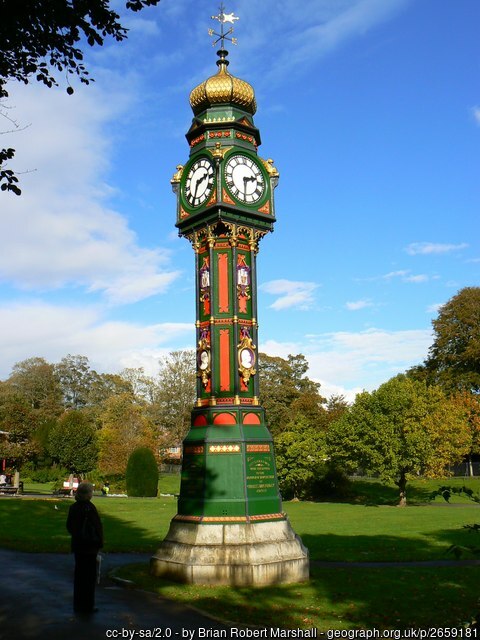
Clock Tower in the Borough Gardens
Photoraph © Brian Robert Marshall
Useful Information
Things change. Always check out the external links for the latest information.
These are just helpful suggestions only.
There is only one affiliate link, SBI.
Travel Wessex is a Guide.

This is a developing map. Some areas have better coverage.
To find the nearest Electric Vehicle Charging Point please click here.
Public Transport
If you do decide the leave the car at home and help the environment too, why not go National Express. They run coaches all over the country. Some pretty good fares too.
Just imagine - sit back and relax, no hassling with the traffic!!!
Do you know that you can book on your mobile phone and they will send the ticket as a text!!!!
National Rail Journey Planner.
For train journeys all over the United Kingdom connecting the places you want to go efficiently and quickly.
Traveline is a very useful resource for public transport throughout Wessex, even local buses. In fact all over the United Kingdom.