Salisbury
Green lush water meadows near the magnificent cathedral give Salisbury a rural ambience. It is an ancient, prosperous, busy and attractive city, the only city in Wiltshire. It lies on the edge of the 300 square mile chalk plateau that is Salisbury Plain.
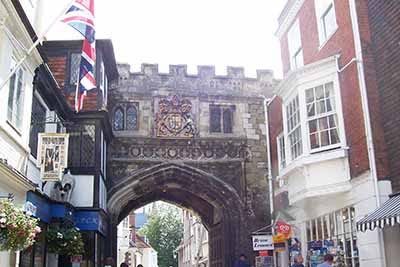
High Street Gate showing architectural styles of many centuries
Photograph © L Temple
Dominated by the incredible cathedral, architecture from every period since the thirteenth century grace the streets. Beautiful medieval buildings that have stood the test of hundreds of years. Chocolate Box half timbered Tudor style evoke thoughts of Henry VIII and Queen Elizabeth I. Gracious Stuart, Queen Anne and Georgian jumble delightfully with Victorian buildings. It is all there, a walk round the streets of Salisbury is a walk with history.
Yet this is a lively city. Plenty of places to eat, drink and shop. Tourism is a major industry and it is catered for.
Five rivers and five major roads meet at Salisbury. There are five gates in the old city wall that surrounds the cathedral.
The gates are: High Street Gate, St Ann's Gate, the Queen's Gate, and St Nicholas's Gate. One built much later than the city wall is the gate that leads to Bishop Wordsworth School in the Close.
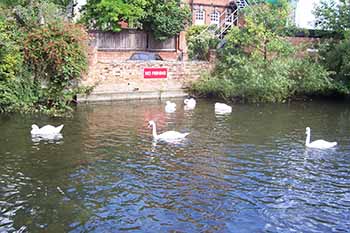
Swans on the water
Photograph © Copyright L Temple
The rivers are the Avon, Bourne, Ebbie, Nadder and the Wylye, in reality the Avon and four tributaries. These days the rivers have new directions feeding the beautiful public gardens and the water meadows at Harnham, both such a feature.
The city has always been an important crossing and the major roads are the A30, A36, A338, A354, and the A345. There are arguably the A360 and the A3094 as well but not so major. Makes for a lot of traffic, but areas in the centre have been pedestrianised.
A most useful place and can be found in Fish Row which is pedestrianised. From High Street walk along Silver Street, Fish Row starts at the end as Silver Street meets the corner of Minster Street.
Shopping
Pretty well a shopaholic's paradise seven days a week. Specialist shops as well as department stores and shopping centres. Try The Maltings Shopping Centre, The Old George Mall Shopping Centre or Cross Keys, Then there is the pedestrian's only High Street. Browse around and find your own favourite.
The Market Place
Another great spot. Market Days are Tuesdays and Saturdays and the area gets pretty busy then. Markets have been held here since 1227. Like many other places there were crosses where the various goods could be sold or a trade plied. Only the Poultry Cross remains to this day. Streets would also have had the names of the trade operating there, some still exist. Moves are afoot to rejuvenate the Market Place and Guidhall area.

Places to visit in this lovely city
The Cathedral
Dominates the city. Beautiful, magnificent, incredible.
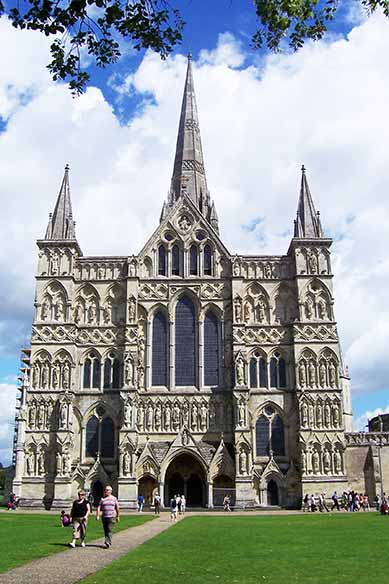
The magnificent west front of the Cathedral.
Photograph © L Temple
Of Early English Gothic design the majority of it was built in 38 years! All on only four feet of foundation on a high water table! That lovely west front was added by 1265.
By 1320 the spire rose to the heavens. Nowadays at 404 feet it is the tallest surviving pre 1400 spire in the world. With the tower it weighs 6,397 tons. Needless to say weight and height have caused problems and it had to be strengthened.
The Library holds the best preserved copy of the Magna Carta and is on display. A copy makes a great memento – Latin or English.
The Cathedral has oldest modern working clock which dates from 1386. No face as in those days clocks rang out the hours on a bell.
Other claims to fame include the largest cloister and
cathedral close in Britain and no ring of bells, which is somewhat unusual being only one of three cathedrals in England without one.
A bell tower which stood nearly 100m away to the norhtwest of the main cathedral was demolished in 1790 when other changes took place.
There are several famous paintings of the cathedral by John Constable as well as Turner.
Salisbury and South Wiltshire Museum - 65 The Close.
Quite a comprehensive and interesting collection. There is a focus on Salisbury, but certainly not exclusively so. Includes an interesting Pitt Rivers Wessex collection. “the father of modern scientific archaeology”. Of real interest if you are a “Time Team” fan! General Pitt Rivers lived nearby in Tollard Royal and created the Larmer Tree Gardens which are open to the public and host to many events.
The Rifles (Berkshire and Wiltshire) Museum – in their words “the story of the Infantry of Berkshire and Wiltshire”. A rather fascinating collection of artefacts to do with these regiments. Well worth a visit.
Some material can also be found online – War diaries which have been
transcribed by volunteers, Regimental timelines etc. Visit the link
above. For Family historians – lots of background information. If you
are coming from any distance check the website for the latest
information regarding opening times etc. Tell them you are coming if you want documents so they have them ready for you.
The Medieval Hall – West Walk, Cathedral Close
A beautiful ancient building.
Was once Salisbury Cathedral Deanery's 'Great Hall' and built during the 1200's.
See the exposed beams of
that fantastic timber roof. What history those beams have witnessed from up high. Now an events venue privately run with caring hands.
Mompesson House – Cathedral Close
This elegant National Trust Property makes for a very pleasant visit. An oasis of peace in a busy world. Sunny day – take tea in the garden – very nice. “Sense and Sensibility” was filmed here – not surprisingly.
You will see them alongside the cathedral. An area of beauty within a busy city. A Site of Special Scientific Interest and an Environmentally Sensitive Area. As they are water meadows the Town Path can get very muddy and impassable at times! The link above makes for very interesting reading. All about the wildlife of the meadows.
Places to visit around this lovely city
Situated at Netherhampton. Take the A3094 – the Netherhampton Road - out of the city. There are buses to the course. There is plenty of information regarding meetings on their website.
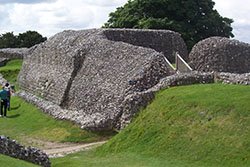
Old Sarum
Photo © L Temple
Can be found two miles to the north on Castle Road. Follow the signs on the A345 out of the city. Red !! Buses run from the city.
It was the site of the earliest settlement and can be traced back 3000 years. Magnificent views were of more use as defence in those days and so it became an Iron Age Hill fort. It remained a fort to Saxon times (in Saxon - burgh) and then the Normans built a castle there for similar reasons.
It was also the site of the original cathedral but because of arguments between the castle and the cathedral factions a new cathedral was built in the valley below.
There are plenty of information boards put up by English Heritage giving the history of the site. Great place for a picnic.
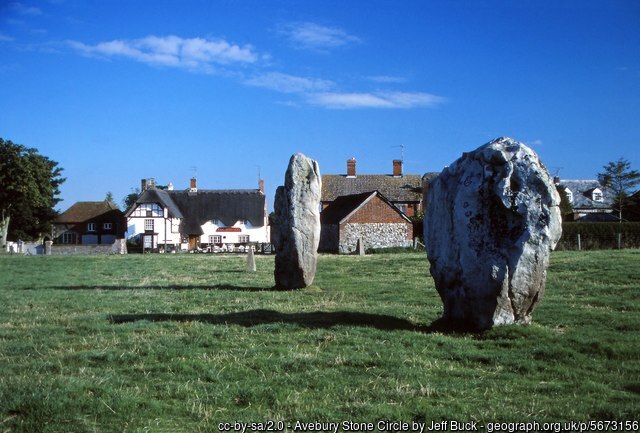
Avebury near the centre of the stone circle
Photograph © Jeff Buck
Avebury Ring is much older and bigger than Stonehenge! Avebury village sits among the stones uniting the ancient and the modern world.
The Red
Lion has ghosts!!!! Spooky!!!
Other pages that may be of interest
Or you might prefer to browse some more, please do, there are navigation buttons above on the left.
Enjoy


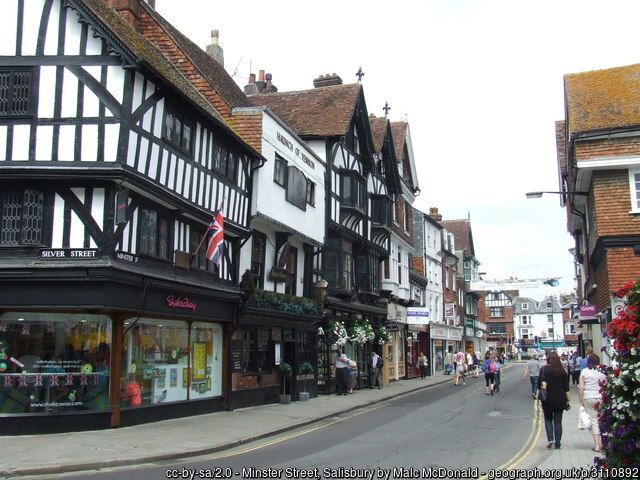
Historic Minster St, Salisbury
Photograph © Malc McDonald
Useful Information
Salisbury International Arts Festival.
Is held at the end of May and into June. A wonderful, vibrant celebration of the arts. No wonder it was this Festival that won a Tourist Event of the Year in the south west.
Magna Carta
2015 was the 800th Anniversary of the Magna Carta, that incredible document that is the basis of both UK and Western Democracy!!!
Salisbury Cathedral has one of the finest copies of the Magna Carta.
Well done Salisbury
Salisbury was No 7 in the TOP TEN CITIES IN THE WORLD TO VISIT IN 2015!!!
Accommodation
A stay in Salisbury just for its own sake is a pleasure in itself. It also makes a most delightful centre as a base for exploring Wiltshire and the surrounding county.
Accommodation is generally plentiful in Salisbury, There are quite a few good hotels as befits such an ancient and popular city. Makes an excellent base to visit Stonehenge and Avebury.
The county of Wiltshire also has a myriad of accommodation possibilities. In both cases it is always advisable to book ahead if you can.
Things change. Always check out the external links for the latest information.
These are just helpful suggestions only.
There is only one affiliate link, SBI.
Travel Wessex is a Guide.

This is a developing map. Some areas have better coverage.
To find the nearest Electric Vehicle Charging Point please click here.
Public Transport
If you do decide the leave the car at home and help the environment too, why not go National Express. They run coaches all over the country. Some pretty good fares too.
Just imagine - sit back and relax, no hassling with the traffic!!!
Do you know that you can book on your mobile phone and they will send the ticket as a text!!!!
National Rail Journey Planner.
For train journeys all over the United Kingdom connecting the places you want to go efficiently and quickly.
Traveline is a very useful resource for public transport throughout Wessex, even local buses. In fact all over the United Kingdom.